You don't have a backup. You have an assumption.
· Roman Miakotin
- resilience
- energy
- infrastructure
- systems-thinking
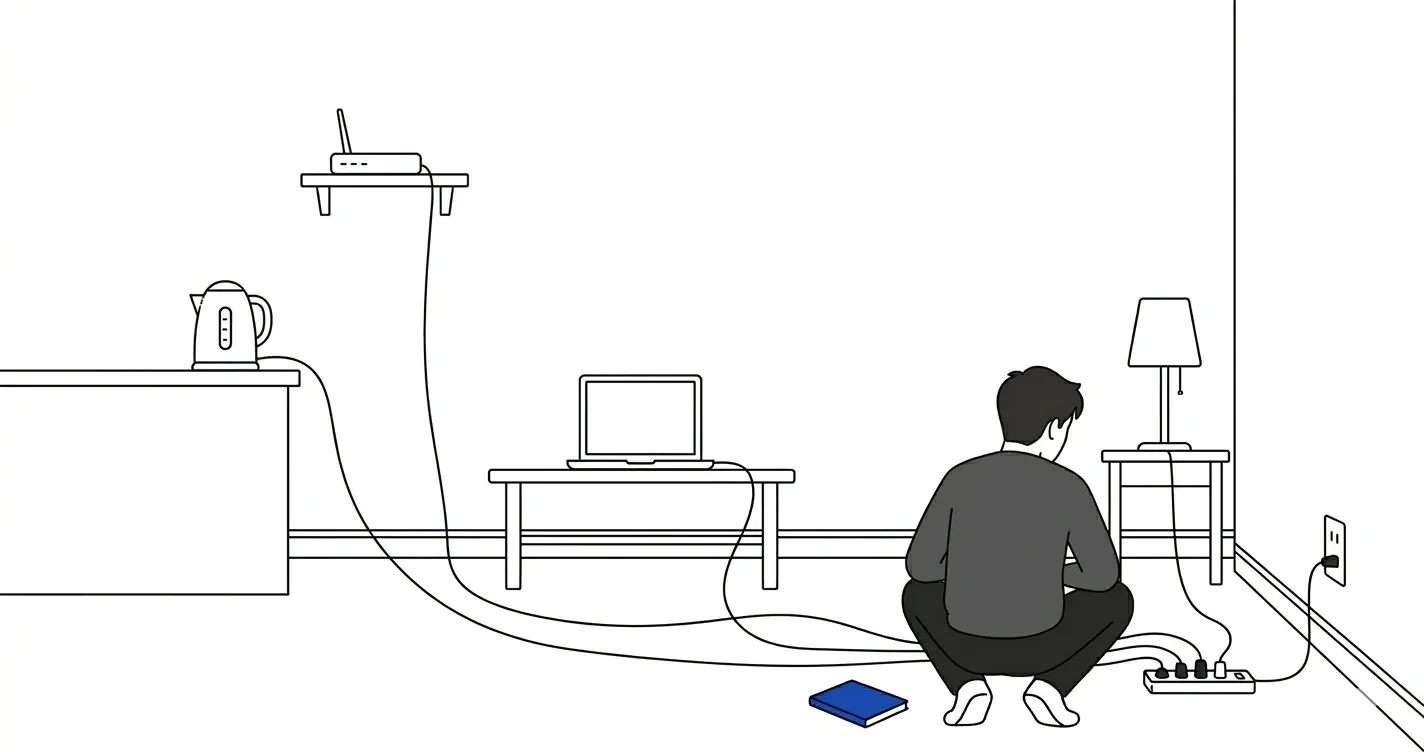
My building is twenty-two floors of concrete with no gas line. The water in the tap, the heat in the radiators, the stove I cook dinner on, the lift, the light to read by — every one of them runs on electricity. For years I never had to know that. Power was simply there, the way the floor is there, and nobody thanks the floor for holding them up.
That’s the trick of a dependency you’ve never watched fail: it doesn’t feel like a dependency. It feels like the world. You don’t move through your day thinking “my home needs the grid.” You think “I have hot water,” “it’s warm,” “dinner’s on” — a dozen separate comforts that feel independent because they have never, not once, gone out together. They were never independent. They were one wire wearing a dozen disguises, and the disguise held only because the wire never dropped.
Then the grid here in Ukraine stopped being something you could assume. Outages went from a once-a-winter accident to a published schedule, and then to no schedule at all. The first long one is clarifying. Within an hour the flat isn’t a dimmer version of itself; it’s a different building. The taps cough and stop — the pumps are electric and the nineteenth floor is a long way from the main. The fridge is now a slowly warming box. The lift is a dead vertical corridor; for the neighbour who can’t take the stairs, that is the whole story. None of this is dramatic. That’s the point — it’s arithmetic, and the arithmetic was there all along.
And because my wife and I both work remotely, the income went out in the same instant as the light, by the same cause. A video call freezes on a colleague’s face and you realise the problem isn’t your router — it’s the building, the block, the city, and nothing you can type fixes it. Two laptops at 60% and falling. A deadline that doesn’t care why.
Here is the part I had wrong — and I think most people have it wrong in exactly the same way. I assumed that if it ever truly came to it, I’d improvise. A generator. A power bank. Candles, blankets, the little camping stove, human ingenuity. That assumption survives precisely until you weigh it against the real load. A power bank refills a phone; it does not push water up nineteen storeys. A generator big enough to carry the building’s pumps and central heating is not a thing you tuck onto a balcony. Candles are not income. The honest finding wasn’t “I need a bigger battery.” It was that I had no fallback at all. I had a story about a fallback — and the story had never been tested, because the thing it was meant to back up had never once been down.
The detail I remember most isn’t dramatic. You either buy the water or haul it from the public pump a few streets over, and either way it comes to the same thing: two canisters, nineteen flights, switching hands every landing because the handles cut white lines into your fingers, counting floors in the dark by the feel of the turn in the rail — for water you used to get by turning a tap. And here is the part that stayed with me: no battery I could ever put in my flat would lift that water. The pump is in a basement I don’t own, on a circuit that was never mine. This wasn’t a problem I could back up. It was a problem I didn’t even get to have an opinion about.
So the next quiet evening I went looking at the rest of it — not asking “how do I back all this up” but a colder question: which of these is even mine to decide? Some of it isn’t. The pump, the lift, the building’s slice of the grid — those simply happen to me; I don’t get a vote. But some of it sits on my side of the meter, inside my own walls. The work that pays for the flat. The food in the fridge. The light to see by. Staying reachable enough to stay employable. Those I can actually make decisions about — badly or well, but mine. The audit didn’t end at one node after all. It sorted the world into the dependencies I could do something about, the ones I could only carry up the stairs, and the ones that unsettled me most: the ones I had never thought to list at all, because they had never once failed.
If you build systems for a living, you already know this shape. It’s the shared database every service quietly reads and no one lists as a dependency. It’s the “we’ll just fail over to the other region” that has never been run under real traffic. It’s the component missing from the architecture diagram precisely because it has never broken, so nobody thought to draw it. We don’t overlook these things because we’re careless. We overlook them because a dependency that has never failed is invisible by construction — its reliability is the very thing that hides it. That is the whole lesson, and a blackout is just an unusually fast way to learn it. It didn’t teach me about batteries. It taught me to mistrust comfort that has never been tested, and to go hunting, deliberately, for the wire everything is leaning on — in my home, and in everything I design.
That’s the short answer to why I spend my time on energy software now. Not because trimming a few percent off a tariff is interesting — it mostly isn’t — but because of the narrow, stubborn space between the dependencies you can’t touch and the few that are genuinely yours. That space is where every real decision lives: the power failing, the data stale, nobody watching, and only a handful of things you actually control — does what’s left get spent on the right ones? Everything I’ve found worth building lives inside that question.
The power is on as I write this. The tap runs, the flat is warm, the work is getting done. That used to feel like safety. Now it reads more like a sentence with the verb left out — fine, fine, fine, right up to the word that isn’t there. By tomorrow the grid will be invisible again. I just don’t get to un-see it anymore.